
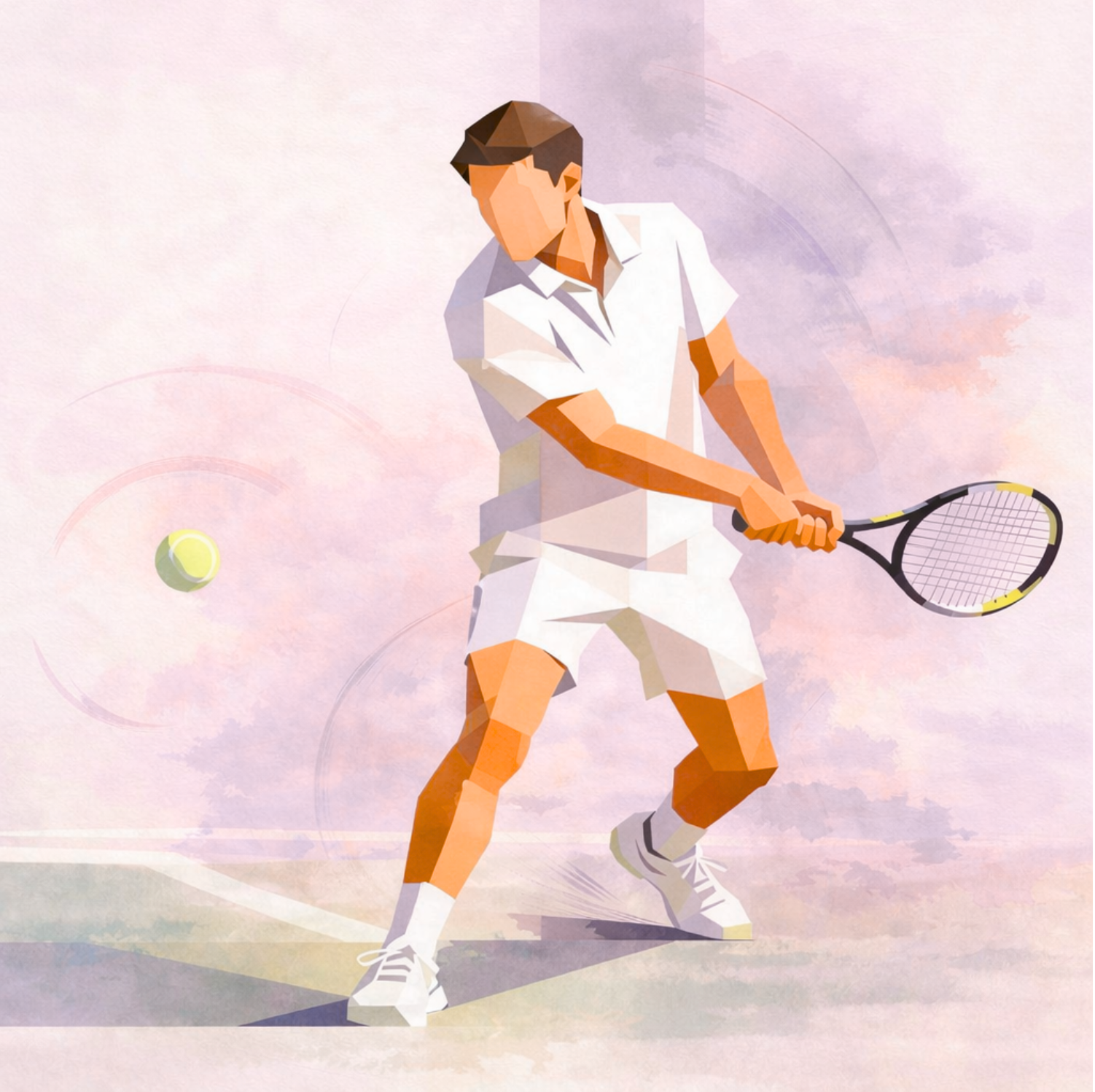
1. Learn the Grip.
Start with a continental grip on your dominant hitting hand followed by an eastern grip on your non-dominant hand. Although there are two grips on the racket handle, do not assume that we must grip the handle tighter. Instead, your grip should be loose enough to enable you to do the following effortlessly:
The racket head in the backhand stroke ought to operate with a combination of these two axes as shown above. Therefore, it is important to loosen your grips for your racket to firstly get under the ball, and also to achieve the wrist lag which aids in the overall stats of the stroke – spin, power and control.
2. Get in “Ready Position”.
Like the forehand, the stroke initiates from the “ready position” which is essentially our home base for groundstrokes (both forehand and backhand). Again, always keep loose, place racket at center (with a comfortable distance from the body), legs spaced wide apart (slightly more than shoulder width), eyes facing front (and alert) and body weight leaning slightly forward.
3. Split Step-Turn Shoulder.
Initiate the split step with a hop on both legs (as a rule of thumb, when the other player hits the ball across from you) and turn your shoulder with the racket at roughly the same level as when you were in ready position. Head must be facing front to watch the oncoming ball and ensure that your belly button faces the side when turning your shoulders to get a good coil on your upper body. The split step and shoulder turn must be thought of as a unit: when one acts, the other must follow, so as to prepare early and not feel rushed when receiving balls to your backhand side.
4. Step In-Drop Racket
Remember the vertical axis in step 1 above? Once you turn, allow gravity to carry out a vertical drop of your racket while stepping in with your foot (some coordination is involved here, practice until you can). Note that the foot must be facing in the direction of the ball (as in the video) with heel (not toes) stepping in first to maintain good balance.
5. Turn Hips-Swing
Go in the order of this pairing and turn your hips first and only then your swing. The reverse order would break the mechanics of the stroke which results in a less effortless and optimised backhand. Your grip must be loose enough to allow for the racket to flow along the horizontal axis here too (see Step 1 above).
6. Contact Ball-Look


The racket face should be roughly flat-facing upon contacting the ball which is akin to giving the ball a “high-five”, or more precisely a “mid-five”. Upon and after contact, it is crucial to look and maintain “eye contact” with the area of contact for a tad longer before breaking away (quite naturally to look at the ball flight) to ensure head stillness. This will maximise power, control and balance through your shot. But how long to look? As a rule of thumb, be neither a creep nor overly coy: look until the verge of completing your follow-through (see gifs below).
7. Extend Arm-Follow Through
After ball contact, extend your arm fully with your non-dominant arm before breaking your elbow for the follow through. To not do so but break your elbow without fully extending through your shot would de-optimise your stroke (see gif below) and prevent you from fully utilising your whole body to execute which leads you to fall short of reaping your backhand’s full potential (of power, spin and depth):
So, extend your non-dominant arm (for right handers, left hand; for left handers, right hand) after contact and only then, break your elbow to follow through (and this is crucial too:) over or around your shoulder.
8. Recover
The backhand has to come full circle and back to our “home base” which is our ready position, so recover well by keeping balance, light on your feet and ready for the next shot.
Congratulations for reaching the end of the article! Here is the full double-handed backhand shot:
Enjoyed this article?
Get a FREE printable infographic, “8 Forehand lessons from Federer” for Recreational Players, when you enter your email below and I’ll send it straight to your inbox. You’ll also receive occasional updates whenever I publish a new article and/or release a new resource.
Looking for personalised guidance? I also offer private tennis coaching in Singapore and create digital training resources to help you improve with confidence, both on and off the court.
📩 Subscribe below and stay in the flow.
Leave a Reply