
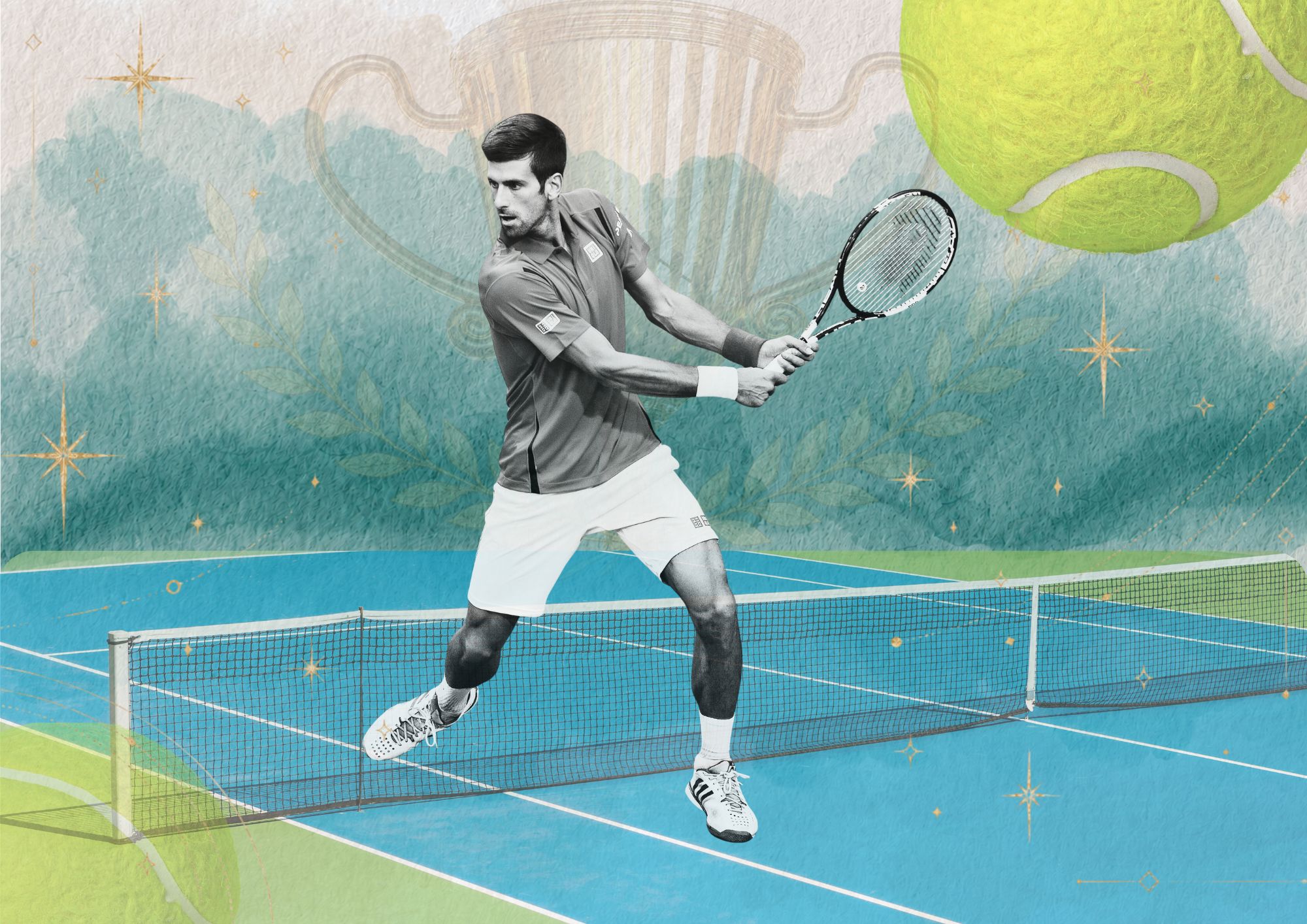
What is it that makes Novak Djokovic’s (a.k.a the GOAT as of 2026) backhand such a reliable and potent shot? And how can recreational players like us who play with double-handed backhands learn from the GOAT? I would like to propose four more principles in this second part of the article (see the first part here).
Principle 5: Step In (Heel First) Into a Closed Stance

While it is certainly possible and even encouraged to hit a backhand from an open stance (where both feet are facing front towards the net) – when one is pressured for time or pulled out wide to the sides – by default one should always aim to be in a closed stance to hit a backhand. This stance is favourable to the double-handed backhand because it allows maximum and easier hip and shoulder rotation thus maximising power and efficiency in the stroke.
Another point to note (especially for beginners) is to step in heel first and not on the mid foot or the forefoot as this provides good balance to the stepping in as contrasted to being “jammed” in if one does not step in with the heel first. As to the direction in which the foot is to step in, a good rule of thumb is to face the foot about 45 degrees from your shoulder blade as seen in the image above.
Principle 6: Drop Your Racket Head to Get Under the Ball

Getting your racket head under the ball to hit the incoming ball allows you to generate top spin and create easy depth across the court. A common mistake beginners tend to commit is not “dropping” the racket head or allowing gravity to assist in dropping the racket head by stiffening up the wrist which results in a not-low-enough drop as well as limiting the power and spin one is able to generate from a loose wrist. Attempting the following two drills might help in loosening your wrist to get under the ball (and also do check out my article here for more details related to keeping loose):
Principle 7: Extend Out Non-Dominant Hand After Ball Contact

Be under no illusion that the double-hand backhand stroke is first and foremost a predominantly non-dominant hand stroke – that is if you are right handed, then your left hand should be the main driver of your double-handed backhand – and vice versa. Thus, after ball contact, drive and extend your non-dominant hand forward to provide a forward drive to the ball aiding in creating depth and power through the court. A common mistake is to close in the elbow of the non-dominant hand too quick too soon resulting in a de-optimised backhand stroke (compare the two strokes below). Be aware of that and seek to extend your non-dominant hand forward.
Principle 8: Follow Through Over/Around Your Shoulder

Last but certainly not least, culminate the backhand stroke with a complete follow through over or around your shoulder to allow the momentum of the swing to take its full course. If in the case where you find that you lack a proper complete follow through then either your elbow is prematurely bent after ball contact (as in the video above) and not extending the non-dominant arm enough or that you are too tense in your arm(s) which results in halting the momentum of the swing. In the former case, practice extending your non-dominant arm after ball contact, and for the latter, train to keep your grip and arm loose.
So there you have it! 8 principles of the double-handed inspired from Djokovic that any recreational player can practice and adopt! To sum up, here is an infographic I created of the all the eight principles combined – and if you like, you may purchase the digital copy here:

Featured image: Adapted from a photo by Roberto Faccenda via Wikimedia Commons. Licensed under cc-by-sa-2.0.
Enjoyed this article?
Get a FREE printable infographic, “8 Forehand lessons from Federer” for Recreational Players, when you enter your email below and I’ll send it straight to your inbox. You’ll also receive occasional updates whenever I publish a new article and/or release a new resource.
Looking for personalised guidance? I also offer private tennis coaching in Singapore and create digital training resources to help you improve with confidence, both on and off the court.
📩 Subscribe below and stay in the flow.
Leave a Reply