
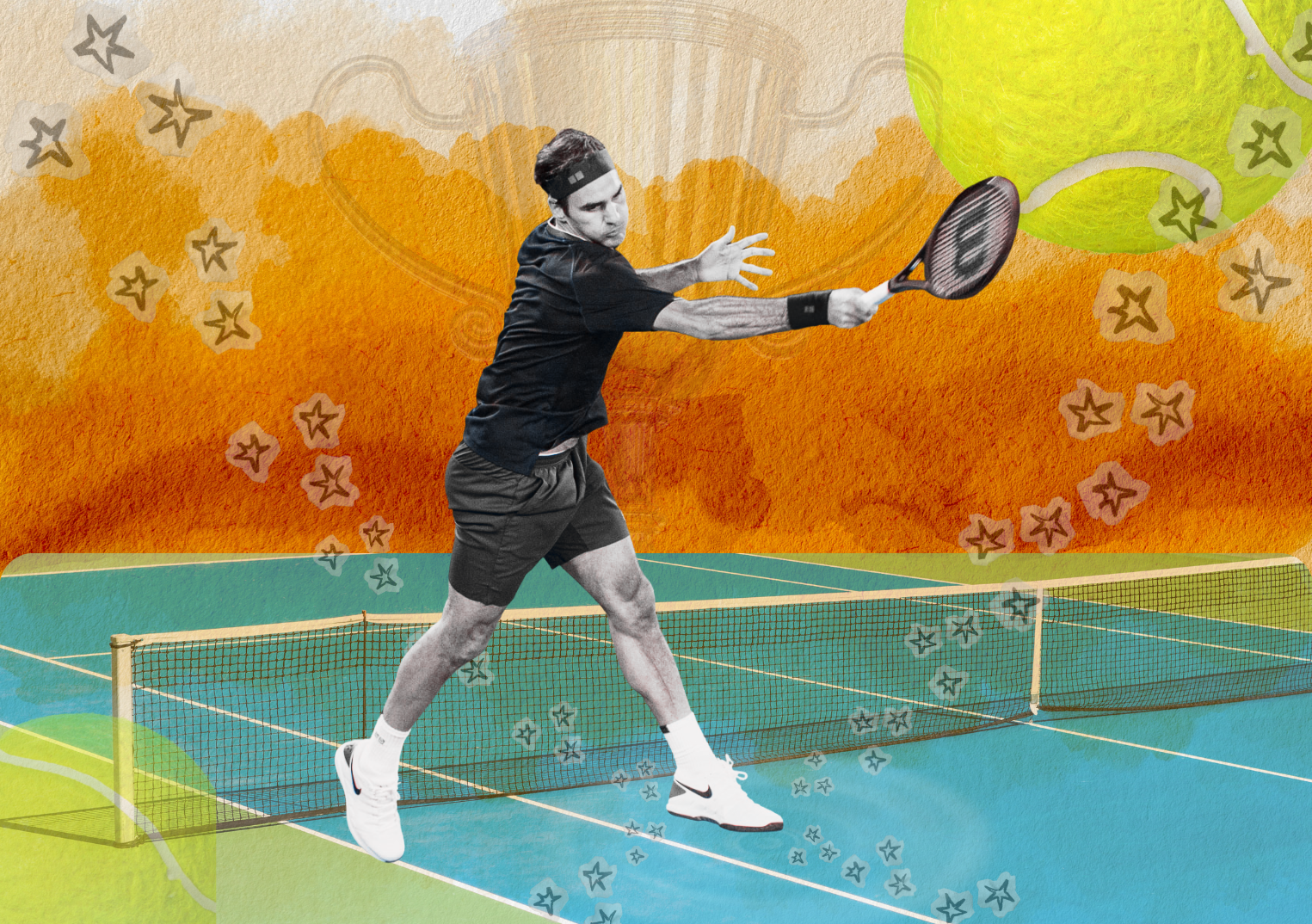
Roger Federer. Winner of 20 Grand Slams. The Artist. The Maestro. The Swiss.
Ready for part 2? If need be, watch the video below again (you may stop at the 30s mark), and here we go!
Lesson 1: Use Your Non-Dominant Arm as a Gauge
Beginning players (or even some seasoned players) seem to be unsure of what exactly to do with the non-dominant hand in a tennis forehand. Simply put, there are three ways to put the non-dominant hand to good use and they are to “push”, “gauge”, and “catch”. For our present purpose, I would like to focus on the second namely to “gauge” (the “catch” would be lesson 4 below, while you may read about the “push” – and more about the non-dominant hand here).


Pay close attention to Roger’s non-dominant hand, and you would notice that his hand is straightened out and relaxed with his fingers spread out in order to gauge the distance of his ideal strike zone. Note that it is not so much pointing at the ball per se but more so carving out an invisible boundary for the strike to occur. And as the ball gets closer, the non-dominant hand begins to curl up to make way for the dominant hand to contact the ball with both hands working in tandem.
So, likewise, if you are struggling with your spacing of the ball, put your non-dominant hand to good use by employing it as a “distance” gauge to put you in an optimal position to strike the ball cleanly with your forehand.
Lesson 2: Rotate Your Hips and Shoulders To Swing Your Racket

A common misconception for a good powerful forehand is to swing only (or mainly) using your arms. This cannot be further from the truth. While certainly the arm plays a crucial role in hitting a forehand, a far more efficient (and less injury prone way) is by engaging not just your arm to swing your racket but also the hips and shoulders. In fact, use your hips and shoulder rotation to swing your racket (of course assuming you have coiled your body sufficiently – see Part 1, Lesson 3).
Observe that Roger does exactly that: after he has dropped his racket, he then proceeds to rotate his hips and shoulders towards the incoming ball while the arm and racket lags slightly behind. Doing so provides both stability in the forehand shot as well as conferring to the hitter easy power (as one is engaging more muscle groups to hit the forehand).
Go ahead, try it out for yourself – instead of merely relying on the dominant arm to swing the racket, rotate your hips and shoulders to swing your racket and feel the difference.
Lesson 3: Look At the Contact Point for Longer

Roger has one of the longest gaze on the contact point amongst most players on tour. After he contacts the ball, his gaze usually lingers for quite some time before he shifts his eyes to look at where the ball has gone.
While you may not necessarily need to look as long as he does, by at least gazing at the contact point area after you have struck the ball ensures firstly consistency in hitting the racket sweet spot – as you are more focussed and (hopefully) anticipatory of where you are going to strike the ball – and secondly, it gives power and control on your forehand shot as your head remains relatively still somewhat serving as a pivot for the other moving body parts (i.e. your hips, shoulders and arms).
Again, attempt it yourself to look for longer at the contact point even after the ball leaves your racket face, and experience its effect on your forehand.
Lesson 4: Catching Your Racket At the End of Your Follow-Through

Last but not least, do catch your racket with your non-dominant hand at the end of your follow-through.
This not only beautifies your stroke but also prevents your non-dominant arm from opposing the force of your hip-shoulder rotation as such:

Instead, one should catch the racket to maximise the momentum of the rotation of the forehand stroke for a more efficient and aesthetic looking stroke:

Herein concludes the “4 Forehand lessons” 2-part series inspired by Roger Federer. Who says recreational players like us can’t hit like the pros? 😉
Featured Image: Adapted from a photo by Rob Keating, Canberra, Australia, Australia via Wikimedia Commons. Licensed under CC BY 2.0.
Enjoyed this article?
Get a FREE printable infographic, “8 Forehand lessons from Federer” for Recreational Players, when you enter your email below and I’ll send it straight to your inbox. You’ll also receive occasional updates whenever I publish a new article and/or release a new resource.
Looking for personalised guidance? I also offer private tennis coaching in Singapore and create digital training resources to help you improve with confidence, both on and off the court.
📩 Subscribe below and stay in the flow.
Leave a Reply